
People often confuse etiquette and tradition, using them as synonyms. In reality, they refer to two distinct concepts:
- Etiquette is a formal code—the set of behavioral norms that define good manners and social decorum.
- Traditions, on the other hand, are customs and rituals tied to a specific region, history, and family context.
While etiquette sets forth well-defined rules, modern traditions and customs continually introduce variations on the theme, reflecting the historical era and local culture.
Jewelry and the Engagement Announcement
- Historical Tradition: The fiancé would give the family ring as a gift, and the bride-to-be would reciprocate with cufflinks to be worn on the wedding day.
- Today: This custom has largely been replaced by the gift of a diamond or brilliant-cut diamond. However, in classic etiquette, the ring passed down from generation to generation still holds irreplaceable value.
Wedding Invitations
- What Etiquette Says: The announcement must be made by the parents of the bride and groom (only if they are alive and not separated), provided that the couple is under 30 years of age and has no children. The stationery must be strictly classic: high-quality paper, English typeface, and sepia-colored ink (no Plexiglass or extravagant materials). The invitation must include the date and location, but never the address of the church, which must be provided separately. The invitation should be delivered by hand or, if mailed, placed in a second padded envelope to protect it.
- Today: Although this formality is still observed in some parts of southern Italy, today it is almost always the bride and groom themselves who announce their wedding, choosing much more informal graphic styles and materials.
Gifts, Wedding Registry, and Thank-You Notes
- Handling Gifts: In the past, it was the bride’s mother who would discreetly inform guests of the couple’s wishes. Today, technology comes to the rescue through dedicated websites and online wedding registries.
- Thank-You Notes: Sending thank-you notes (within a month of the wedding or upon returning from the honeymoon) isn’t just a matter of etiquette or tradition, but of pure kindness and good manners. It’s a good idea to personalize the note by mentioning the gift you received (e.g., “Every time I serve coffee in this cup, I think of you”).
Clothing and Style Details
- The Bride: Traditional etiquette calls for a veil, sheer tights, and gloves (elbow-length in winter, wrist-length in warmer seasons, to be removed once she reaches the altar).
- The Groom: He may wear a morning suit for morning ceremonies or a tuxedo (blue or gray, never black) if he changes into evening attire.
- Guests: Colors such as black, red, or overly flashy shades are considered taboo: the golden rule of etiquette is never to draw attention away from the bride.
Flowers and Orange Blossoms
- Etiquette: Exotic flowers or those with an overly strong scent are off-limits.
- The Bouquet: Traditionally, it is the last gift the groom gives to his future bride before she says “I do,” accompanied by a card. In some regions, such as Calabria, local customs take precedence, in which the mother-in-law gives or hands over the bouquet, or the bride and mother-in-law exchange a double bouquet as a gesture of welcome.
Understanding the difference between etiquette and custom allows us to make informed choices: it’s up to us to decide how strictly to follow the rules of etiquette and how much to give in to traditions or modern trends, always remembering that good taste and kindness remain the guiding principles behind every choice.
A story from my work: when logistics meets emotion
People often ask me if rules should always be followed, no matter what. My answer is: it depends! The true purpose of etiquette is to make people feel comfortable, not to restrict them. Let me tell you what happened to me recently at a wedding.
Traditionally, during the ceremony, the bride’s relatives and friends sit on the left and the groom’s on the right. On this particular occasion, however, the couple was positioned so that, when they exchanged their vows, they would be facing each other. If we had followed the traditional arrangement, the bride (seated on the left), when looking toward the groom, would have had her family and friends out of her line of sight, and vice versa.
Together with the bride and groom, we made a decision that went against the norm: we switched the guests’ seats. That way, during the exchange of vows, the bride only had to glance out of the corner of her eye to meet the emotional gazes of her parents and friends—and the same was true for the groom.
It was a slight departure from the norm, but it gave the couple a priceless moment of eye contact with their loved ones during the most touching moments. This is my role as a wedding planner: to understand etiquette and traditions so that I can adapt them with intelligence and empathy to the real needs of each couple.
Plan Your Wedding by Balancing Tradition and Contemporary Style
Finding the right balance between the rules of etiquette, family traditions, and personal preferences isn’t always easy. As a wedding planner, my goal is to guide you step by step in creating an elegant, harmonious event that is authentically yours, without the stress of having to manage etiquette, vendors, and logistics. Whether you’re looking for a classic, traditional wedding or a modern, unconventional event, I’ll handle every detail with care and discretion.
📩 Let’s talk about your special day! Request a free initial consultation: we’ll turn your dreams into a flawless plan.

Frequently Asked Questions: Etiquette vs. Tradition
Who is supposed to pay for the wedding according to etiquette, and what happens today?
- Etiquette / Tradition: In the past, expenses were strictly divided between the families: the bride’s family covered the costs of the dress, invitations, trousseau, reception, and floral decorations, while the groom’s family paid for the venue, the ring, the bouquet, and the honeymoon.
- Today: In most cases, the bride and groom themselves cover the entire wedding budget, possibly with a voluntary and generous contribution from their respective families.
Can the witnesses and parents wear black or white?
- Etiquette: White is reserved exclusively for the bride. Black should be avoided for daytime or religious events (as it is traditionally associated with mourning), although an elegant dark-colored dress is now acceptable for evening receptions.
- Today: We strongly advise against all-white or cream/ivory tones for all guests, while dark or black evening wear is now widely accepted, provided it is accessorized with bright or colorful pieces.
Is it mandatory to give out party favors, or can you skip it?
- Etiquette / Tradition: The wedding favor containing five sugared almonds (symbolizing health, wealth, happiness, fertility, and longevity) is a long-standing tradition as a gesture of thanks.
- Today: Many newlyweds choose to replace it with charitable donations, “gastronomic favors” featuring local products (olive oil, wine, honey), or useful design items, combining traditional meaning with modern practicality.
Who should enter the church or the ceremony venue first?
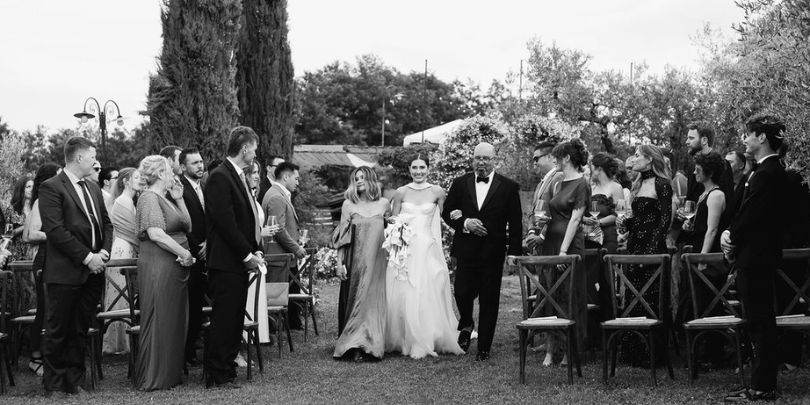
- Etiquette: The groom enters first, accompanied by his mother (or another significant figure), and waits for the bride to arrive at the altar. The bride enters last, on her father’s arm, with her face covered by a veil (if applicable).
- Today: This rule of etiquette is one of the most beloved and respected, even in modernized symbolic and civil ceremonies.
How should you handle it if there are separated couples or extended families among the guests?
- Traditional etiquette: It called for strict hierarchies regarding seating charts and announcements (e.g., separated parents were not mentioned together).
- Today: The fundamental rule of modern etiquette is empathy and respect for everyone’s peace of mind. When arranging seating (tableau de mariage) and handling invitations, the focus is on naturalness and family harmony, avoiding situations that might cause discomfort.

