Every couple has the right to choose the ceremony that best represents them, and there are, of course, various paths one can take. My role as a wedding planner is to help you navigate these options, personalize every detail, and ensure the ceremony is a perfect fit for you—much like a bespoke, tailor-made garment.
What is meant by “wedding ceremonies”
The types of wedding ceremonies available in Italy include civil ceremonies and civil unions (which are legally recognized), religious ceremonies (such as Catholic or other Christian rites; Islamic *Nikâh* ceremonies—which may take place in a mosque or at home, overseen by a guardian, or *Wali*, and an Imam; or Jewish ceremonies, which feature a *chuppah*, the reading of a *ketubah*, the breaking of a glass, and various blessings), as well as a wide range of symbolic ceremonies (such as the sand ceremony, the candle ceremony, the tree-of-life ceremony, etc.). Unlike symbolic ceremonies, which hold no legal standing, religious ceremonies can be legally recognized—provided the marriage is registered with the Italian Civil Registry—though this requires the completion of formal marriage banns (*pubblicazioni*) at the couple’s local municipality in advance.
The Civil Ceremony
The most obvious place to hold a civil ceremony is at the town hall (ideally, though not necessarily, in the municipality where you reside). Alternatively, you may choose one of the many authorized off-site venues—wedding locations that have officially obtained this status—of which there are now a great number. The ceremony itself is very simple, and rather sparse, consisting essentially of the reading of Articles 143 through 148 of the Civil Code, which outline the rights and duties of spouses. Following the reading of the marriage document, the two witnesses and the couple sign it. If you wish to enrich your civil ceremony, you can include a speech; you can find a complete guide on how to do so here.
In principle, a civil marriage ceremony is officiated by a Civil Status Officer (typically the mayor of the municipality or their delegate); however, this role may also be delegated to an Italian citizen who meets the requirements for election as a municipal councillor (i.e., they must be of legal age and enjoy full civil and political rights). While a close relative in the direct line of descent is excluded from performing the ceremony, a relative outside the direct line—specifically one beyond the second degree of kinship—may officiate.
A civil union, by contrast, involves two adults of the same sex who must make a declaration before a civil registrar in the presence of two witnesses—much like the procedure for a civil marriage between two people of different sexes. The act is then recorded in the civil registry. The primary differences compared to a civil marriage concern certain matters—such as joint adoption and the obligation of fidelity—which are not provided for in a civil union.
What, then, are the steps for getting married at a municipal office (town hall)?
To get married at a municipal office, you need:
– an identity card
– a birth certificate
– a certificate of residence
– a certificate of citizenship
– proof of marital status (a statement confirming that you are not currently married)
Next, you schedule an appointment at the town hall of your place of residence, bringing along a €16 revenue stamp for each person. You submit all the required documents, sign the paperwork, and then wait for an email regarding the marriage banns (which were once posted physically at the town hall, but since the advent of the internet, are now handled exclusively in digital format). Once the email arrives—usually after about ten days—you should contact the municipality where you intend to hold the wedding. This same procedure applies even if you are getting married at a venue that is officially designated as a municipal building (a “town hall” location).
Civil marriage for foreigners
The situation is different if at least one of the parties getting married is a foreign national. In such cases, a *nulla osta* (certificate of no impediment) is required; this can be obtained from the individual’s home country’s consulate in Italy or from the competent authority in their home country, by providing a photocopy of their passport. A foreign national wishing to marry in Italy must submit a declaration to the civil registrar—issued by the competent authority of their home country—stating that, under the laws to which they are subject, there are no legal impediments to entering into that specific marriage. Documents issued abroad must be translated into Italian and legalized by the relevant Italian authority in that country (a consulate or embassy) or via an *apostille*. The signature of the consul or ambassador must subsequently be legalized by the competent Italian Prefecture. The following countries are exempt from this legalization requirement: Austria, Belgium, Bosnia and Herzegovina, Estonia, Cyprus, Croatia, Denmark, France, Germany, Great Britain, Greece, Ireland, Liechtenstein, Luxembourg, Macedonia, Montenegro, Norway, the Netherlands, Poland, Portugal, the Czech Republic, the Republic of Moldova, Romania, Serbia, Slovenia, Spain, Sweden, Switzerland, and Turkey. An increasing number of couples are choosing a symbolic ceremony for their wedding, preferring it over a civil or religious one.
There are many reasons for this choice, which, in my view, are both practical and emotional in nature. Before proceeding, however, a clarification is necessary. A symbolic ceremony carries no legal or religious weight; it is a promise that holds meaning only for the couple themselves, not for the State or any religious institution. So, why choose a symbolic wedding?
When it comes to destination weddings—that is, weddings where foreign nationals come to Italy to get married (or vice versa)—the bureaucratic side of things can be highly complicated, as it often requires dealing with one’s consulate, finding a qualified interpreter, and navigating a whole series of other tedious steps. Even when the ceremony is religious, the procedure remains quite complex. This is why those who choose to marry abroad often opt to hold a symbolic ceremony, having already completed a civil marriage in their home country.
Quite simply, couples who choose this type of ceremony often do so to avoid a civil wedding officiated by a registrar, which typically involves nothing more than a dry, perfunctory reading of articles from the Civil Code—stripping the occasion of any emotional resonance. There are many rituals that can be incorporated into the ceremony to make it truly personal; the only limit is your own imagination. Let’s explore some of these options together—and be sure to read until the end, as I’ll be sharing a few extra tips!
Symbolic Rituals
Symbolic rituals (unlike civil ceremonies or religious ceremonies that are legally registered) have no legal standing. However, they can hold immense personal significance—and, best of all, they offer the great advantage of being able to take place anywhere! A symbolic wedding ceremony is not limited to a single format; it can take many forms—potentially infinite—defined only by our imagination and the meaning we choose to assign to a specific ritual.
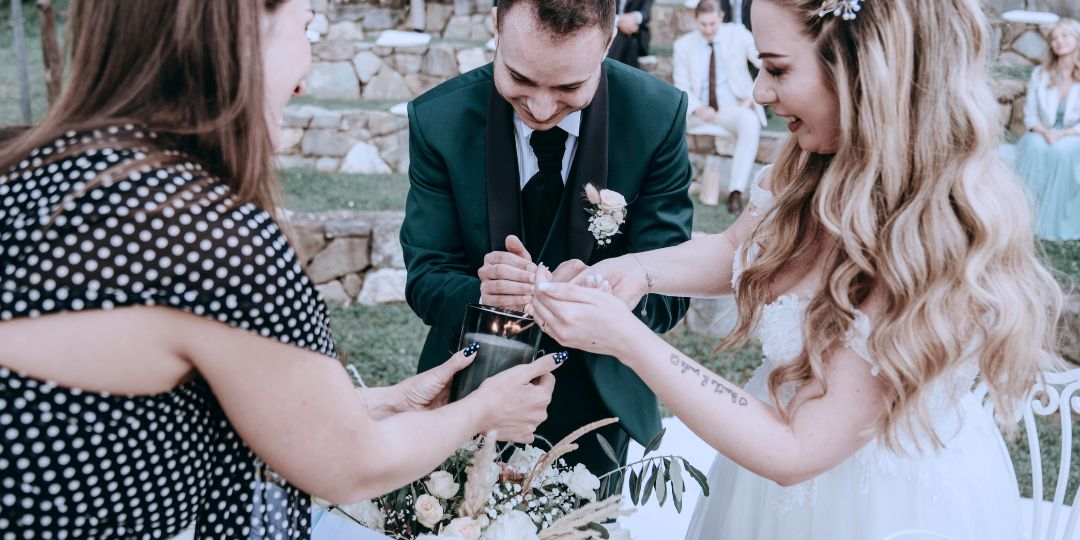
Some of the most well-known include: the sand ceremony (where colored sand is poured into a single vessel); the candle ceremony (in which the couple uses their individual candles to light a larger, central candle); and the handfasting ceremony (an ancient Celtic wedding tradition in which the couple’s hands are bound together with ribbons or cords to symbolize their union).
Other, less well-known rituals include: the earth ceremony (a variation of the sand ceremony, which can incorporate, for example, a flower bulb that blooms every spring); the fairy tree ceremony (where notes containing wishes and good tidings—written by the couple and their guests—are hung on a tree); and the wine ceremony (in which a box containing a bottle of wine is sealed with wax, to be opened and enjoyed by the couple on their first wedding anniversary).Wedding rituals: between tradition and meaning
What is truly meant by a “wedding rite”? Consider that even the exchange of wedding rings is a rite, and it has nothing to do with the legal validity of the marriage itself. It is simply a tradition that has become so deeply embedded in our culture that it is now a customary practice. In the same way, we can define “wedding rites” as any ceremony or ritual—consisting of specific gestures and words—to which the meaning of uniting two people in marriage is attributed. Returning to the example of wedding rings: there was once an ancient belief in the “vena amoris” (vein of love)—a supposed vein that connects the left ring finger directly to the heart. This belief, which dates back to the ancient Romans—and perhaps even earlier, to the Egyptians—has been passed down to the present day, much to the delight of goldsmiths and jewelers.
The Candle Ceremony<br/>
The bride and groom each hold a lit candle, representing their individual love. Together, they use these candles to light a larger one, which symbolizes the couple; from that moment on, it burns as a sign of their new life together. Long a tradition in Germany and the United States, this ritual has also gained significant popularity in Italy.
Sand Ceremony
The sand ceremony, as part of a wedding, traces its origins back to Native American peoples and Hawaiian tribes; it is believed that they used it during beach weddings to symbolize the union of two spirits into one. The concept is much the same as that of the unity candle ceremony, with the difference that sand—which can be colored—is used instead. The couple will have two containers (ideally transparent, such as glass or crystal) filled with colored sand. At a specific point during the ceremony, this sand is poured into a larger vessel, representing the two lovers who have joined together in marriage.
Handfasting Ceremony<br/>
This ancient ritual has Celtic origins; it is, in fact, quite common within Germanic and Anglo-Saxon traditions and symbolizes the union of both bodies and souls. According to tradition, 13 colored ribbons were used, each representing different qualities and virtues: red—passion and desire; orange—vitality; yellow—confidence and joy; blue—sincerity and patience; green—health and fertility; purple—wisdom; black—stability; white—purity and peace; brown—home and earth; gray—balance; pink—tenderness and romance; silver—creativity; gold—prosperity.
Who can officiate a wedding?<br/>
While a civil marriage requires specific legal criteria to be met, a symbolic ceremony is entirely flexible; it can even be officiated by a friend of the couple—for instance, someone who does not hold Italian citizenship. If you wish to have a friend—or a professional celebrant who is not affiliated with the municipality—officiate your civil ceremony, you must inform the local authorities and submit a formal request for a delegation of authority (*delega*) to the Mayor. This request is typically granted, and you will be asked to provide the celebrant’s identification document. Depending on the specific procedures of the municipality, the official documents may either be delivered to the venue by municipal staff at the agreed-upon time, or the celebrant may be required to collect them from the municipal office; as practices vary, it is always best to inquire in advance.
Example of a request for delegation of authority to the Mayor:
Dear Mr. Mayor,<br/><br/>
We are writing to request that you delegate the solemnization of our civil marriage ceremony to Mr./Ms. _______________________ (please provide: date of birth, place of residence, and tax identification number).
The wedding will take place on _________ at _________ at _____________________________________.
Thank you for your time and attention; we look forward to your kind response.
Best regards.
How do I choose the right ceremony for us?<br/><br/><br/><br/>
For couples where at least one partner is a believer, a religious wedding is the most natural choice (though if one partner is an atheist or was baptized in another Christian denomination, a special dispensation must be requested from the bishop). For non-believing couples, those entering into a second marriage, or those from different religious backgrounds (for example, an Orthodox Christian and a Muslim), the only alternative is a civil ceremony (or a civil union), which can be further enriched by one or more symbolic rituals. Foreigners wishing to marry in Italy often opt directly for a symbolic ceremony, precisely to avoid the lengthy bureaucratic processes in Italy.
A Tip from the Wedding Planner
Well, as promised, we have reached the section dedicated to advice on how to best organize your wedding.<br/><br/>
1. Each of these rituals can be incorporated into a civil ceremony to personalize it, while ensuring the marriage remains legally valid. In this case, however, it is best to designate someone else to act in place of the Civil Registrar—this could simply be a friend, or you might choose to hire a professional celebrant who specializes in this role.
2. In principle, the same applies to religious weddings; however, in this case, it is best to discuss it right from the start with the religious officiant, as they may not necessarily allow you to include a ritual that has pagan origins or otherwise belongs to different traditions in your wedding ceremony.
3. The only limit is your imagination. These are just a few of the most well-known examples, but you could also come up with your own, based on your experiences, personalities, and the way you live your life as a couple. You could create a ritual that holds a unique meaning for the two of you.
4. In general—but especially in this latter case—I suggest you turn to a professional: a celebrant who does this for a living, is well-trained, and knows how to speak in public. If, on the other hand, you wish to ask a family member or a friend, ensure that they are someone accustomed to speaking in front of an audience and capable of conveying a proper sense of solemnity.
In any case, each of these rituals can be personalized—to a greater or lesser extent—so that it fits the couple perfectly. That is precisely why listening to you and analyzing your specific situation is so important. So, if you are still unsure about which ritual best suits your own story, please reach out: I will help you find the right one and make it truly your own.