
Planning awedding reception involves striking a balance between aesthetics, logistics and financial management. To ensure the event runs smoothly and without a hitch, it is essential to analyse cost management and operational details in depth. The combination of the venue and catering accounts for around 50 per cent of the total wedding budget. Carefully assessing every single variable is the only way to protect the budget from unpleasant surprises at the end.
Choosing the Venue: In-house Restaurant vs. External Catering
Choosing the venue is the first strategic decision to be made, as it has a direct impact on costs:
- Exclusive Catering + Venue: Choosing a historic house or villa that requires an external catering service typically results in a 30 per cent increase in price compared to a venue with an in-house restaurant.
- In-house restaurant: If your budget is limited, a venue with its own kitchen and restaurant is the ideal option for keeping costs down.
- Midweek strategy: An excellent way to make the most of your budget is to opt for midweek days or Fridays. In these cases, the best choice is to have an evening wedding: guests will have time to finish their working day or take a short break, ensuring they arrive on time for the celebrations.
Still not sure which type of venue best suits your style? I’ve discussed this in detail [in this article –click here to find out more]
Table Decor and Setting
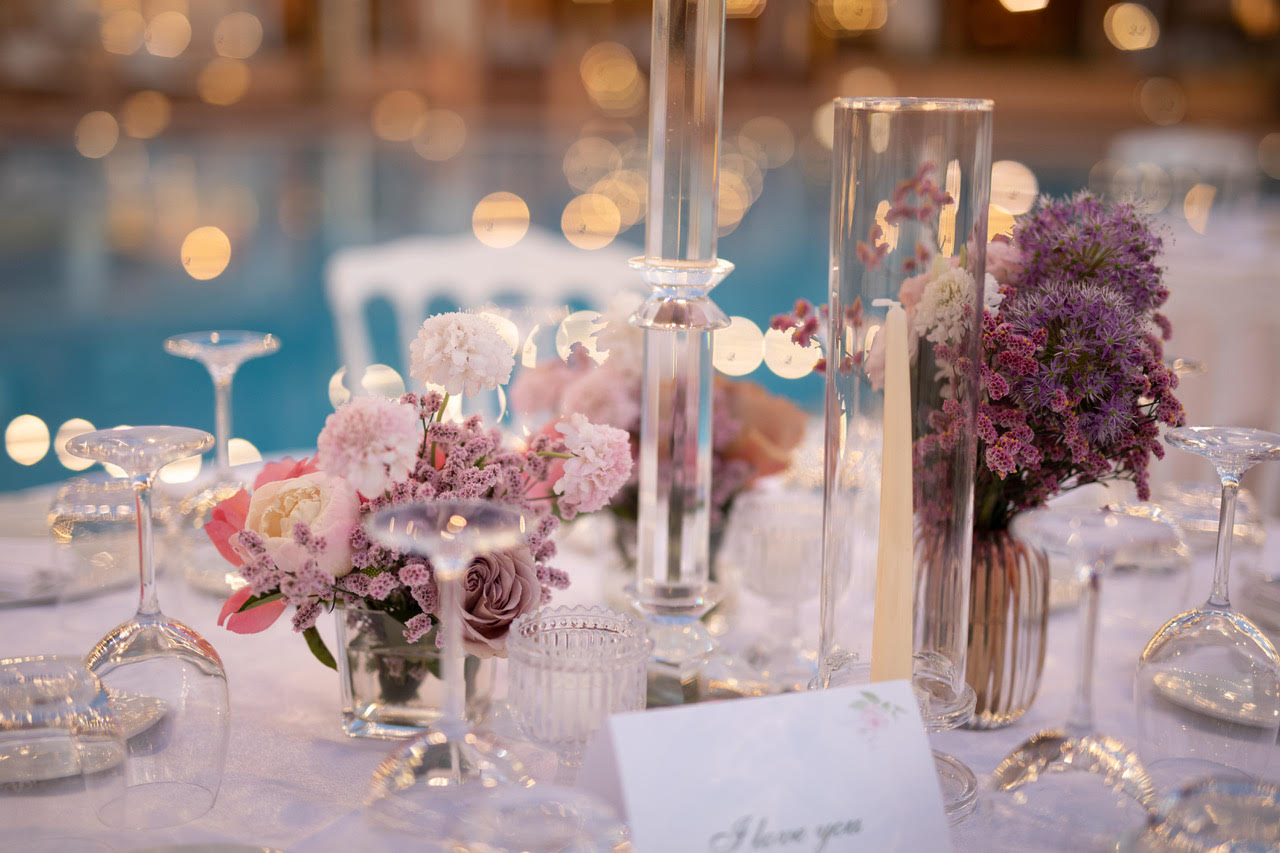
When planning the table setting, it’s important to bear in mind that setting the table goes far beyond the decorative elements of flowers and candles. The second key area of expenditure includes table linen, plates, glasses, cutlery and other tableware:
Cutlery and Chairs: The type of cutlery is always selected on the Chef’s recommendation; it is essential to ensure that it is never too heavy. As for chairs, it is also advisable to opt for stackable models: they offer significant cost savings compared to non-stackable ones, thanks to substantially lower transport and handling costs.
Basic set-up vs. bespoke hire: Restaurants and catering companies provide a basic set-up included in the price. However, if you require specific or designer items, you will need to arrange hire from an external supplier, which will affect the final price.
Calculating the number of plates and allowing for breakages: The hire cost per plate must be multiplied by the total number of courses. A margin must then be added to this figure to allow for any breakages – a normal cost that should be factored in at the outset, amounting to around 20 per cent.
The Anatomy of Tables: Round or Rectangular?
The arrangement of the tables determines both the aesthetics of the dining room and the smooth running of the service.
The Round Table
Standard round tables have diameters of 160 cm, 180 cm or 200 cm:
- The 160 cm table is perfect for comfortably seating between 6 and a maximum of 8 people.
- It creates a classic, intimate atmosphere: the ideal space for a single place setting is, in fact, 60 x 45 cm. Although the social event requires diners to sit close together to encourage conversation, this is not a business dinner, and it is important to ensure there is sufficient space for everyone’s comfort.
The Imperial Table
Genuine imperial tables are designed to seat no more than 80 guests and are characterised by their crescent-shaped end.
- Catering companies often propose layouts using rectangular tables placed side by side: an excellent solution, provided the width is at least 1 metre (ideally 1.20 m).
- This layout takes up more space than round tables. Consequently, to ensure the service runs smoothly, the number of waiting staff should be doubled, as it is more difficult for staff to move about.
Food & Beverage: Proportions, Service and Logistics
Managing front-of-house and drinks service requires mathematical precision and flawless coordination.
Table Service Guidelines
- Water and Bread: Water jugs and the bread basket can either be placed directly on the table from the outset or handled entirely by the waiters as part of the service.
- Wine: Drinks and specific glasses (such as red wine glasses) are brought to the table later on request, should they not be included in the initial set-up.
- Sommelier: The inclusion of a dedicated sommelier incurs an additional cost, as this is a specialised professional role. It should be noted that the sommelier will deal exclusively with pouring and serving wine, not water.
Dining Room Staffing Ratio
To ensure an impeccable standard of service, the optimal ratio is 1 waiter for every 8 guests (maximum 1:10). Catering companies often tend to base their calculations on higher ratios, generally 1 waiter for every 12–15 guests: it is advisable to clarify this contractual aspect from the outset, along with the associated additional costs. For beverage service alone, 1 staff member for every 20 people is sufficient.
The Wedding Planner’s Tip: Stock Management
Please note: It is an unforgivable mistake to find yourself in a situation where you have run out of wine because of poor planning!
To calculate the ideal quantities with great precision, use this formula:
- White wine: 1 bottle for every 2 guests.
- Red wine: 1 bottle for every 4 guests.
- Safety margin: Always add a total of 20 per cent to your stock.
If the bride and groom choose to supply the wine themselves:
- The maître d’ must count the bottles upon arrival of the crates and count the empties at the end of the reception.
- Any remaining unopened bottles must be handed over to the bride and groom without fail.
- Magnum size: Magnum bottles offer slightly better value for money than the standard size, ensure better preservation of the product and create an extremely striking visual effect.
Types of Service and Operational Details
The choice of service style determines the pace and success of lunch or dinner:
- Italian-style service (Recommended): This is the method favoured by caterers and is indeed the best in terms of efficiency. It involves the dishes being plated up in the kitchen, with any final adjustments carried out ‘English-style’ by the waiter directly at the table.
- French-style or Russian-style service: French-style service (where the serving dish is left in the centre of the table) or Russian-style service (where food is portioned out in front of the guest as they eat) are decidedly less practical and slow down the flow of service in the dining room.
Textile Details and Coordination
Timings and Entertainment: If musical entertainment, dancing or guest performances are planned during the day, it is essential to draw up a programme in consultation with the banqueting team. Speeches and entertainment must always be scheduled exclusively between courses, so as not to disrupt the kitchen’s work and to maintain the ideal serving temperature of the dishes.
Outdoor Receptions: If you are holding an outdoor banquet, make sure the caterers provide clips to secure the tablecloth underneath, unless you opt for an Anglo-Saxon style (without a tablecloth).
Textile Care: Ensure that the table linen is immaculate, clean and free from creases. On-site ironing incurs an additional cost, which should be taken into account. The ideal length is for the tablecloth to just graze the floor (unlike the French style, which favours tucking it in underneath).
Shall we organise your dream wedding together?
Planning a flawless reception requires an eye for detail, precise budget management and seamless coordination. From choosing the table settings to orchestrating the day’s proceedings, my aim is to ensure you can experience every moment stress-free, simply savouring the magic of your special day. Do you have concerns about managing your budget or don’t know where to start when choosing the perfect venue? Contact me for an initial consultation: together we’ll explore your ideas and bring to life the wedding you’ve always dreamed of!

Frequently Asked Questions about Wedding Receptions
- How much of the total budget is accounted for by venue and catering costs? The combined cost of the venue and catering accounts for around half (approximately 50 per cent) of the total cost of a wedding. It is therefore one of the most important items to monitor carefully to avoid any unpleasant surprises at the end.
- Is it better to choose a venue with an in-house restaurant or an external catering service? Opting for an external catering service combined with a hired venue increases the cost by an average of 30 per cent compared to a venue with an in-house restaurant. If your budget is limited, the latter option is definitely recommended.
- How do you work out how much wine you’ll need for the reception? As a general rule, allow 1 bottle of white wine for every 2 guests and 1 bottle of red wine for every 4 guests, always adding a 20 per cent buffer to be on the safe side, so as to ensure you don’t run out of wine during the party.
- What is the ideal ratio of waiters to guests for impeccable service? To ensure maximum efficiency and attention to detail, the ideal ratio should be 1 waiter for every 8 guests, up to a maximum of 1 in 10. For drinks service alone, 1 waiter for every 20 people is sufficient.

