
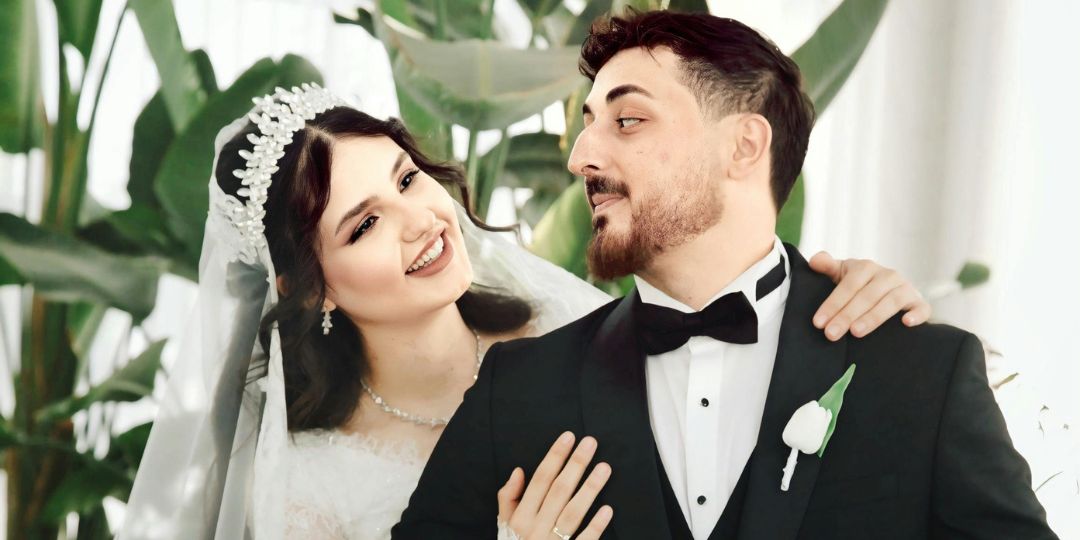
A Jewish wedding is rich in symbolism and traditions, and today I want to tell you about the most important and meaningful ones. If you’re invited to a Jewish wedding, you’ll already know what to expect. Common features of a Jewish wedding include a ketubah (marriage contract) signed by two witnesses, a chuppah or huppah (wedding canopy), a ring belonging to the groom that is given to the bride under the canopy, and the breaking of a glass.
The Importance of Engagement in Jewish Tradition
First of all, we must note that, according to Judaism, marriage is divided into two main stages: kiddushin (the betrothal) and nissuin (the wedding). In traditional weddings, two blessings are recited before the betrothal: a blessing over wine (which is tasted by the couple) and the betrothal blessing, as prescribed in the Talmud. Even the engagement itself (when the groom gives the bride a ring or another valuable object to ask for her hand in marriage) is considered highly significant, and a formal religious divorce is required to dissolve it. While historically these two events could take place a year apart, today they are usually combined into a single ceremony.
The gift of a ring to seal the engagement
According to Jewish law, the ring must be made of pure precious metal (preferably gold or silver; alloys are discouraged), without gemstone settings or other decorations. However, Orthodox couples often wear a simple gold or silver wedding band during the ceremony to fulfill their halachic obligations, and after the wedding, the bride may wear a ring with any decoration she wishes.
The groom gives the bride a ring (traditionally a simple wedding band) and recites the declaration: “Behold, you are consecrated to me with this ring according to the law of Moses and of Israel.” The groom then slips the ring onto the bride’s right index finger; it is usually moved to the left ring finger after the ceremony, as is customary. One plausible reason for using the right hand instead of the left is that in the past, oaths (in both Jewish and Roman traditions) were traditionally (and biblically) taken with the right hand. According to traditional Jewish law, two valid witnesses must be present when he places the ring on her finger.
At some egalitarian weddings, the bride also gives a ring to the groom, often inscribed with a quote from the Song of Songs: “Ani l’dodi, ve dodi li” (I am my beloved’s, and my beloved is mine), which may also be engraved on the ring itself. This ring is sometimes presented outside the chuppah to avoid conflicts with Jewish law.
Signing the Marriage Contract: The Ketubah
Before the wedding ceremony, the groom agrees to be bound by the terms of the ketubah (the marriage contract) in the presence of two witnesses, who then sign the ketubah. The ketubah details the groom’s obligations toward the bride, including food, clothing, and marital relations. This document serves as a legally binding agreement that is often produced as a handwritten manuscript, framed, and displayed in the couple’s home. The signed ketubah is then read (usually in the original Aramaic) under the chuppah.
The Wedding Canopy
The traditional Jewish wedding ceremony usually takes place under a chuppah (the wedding canopy), which symbolizes the new home the couple will build once they become husband and wife. In some weddings, the tallit (a Jewish ritual shawl, often white with blue or black stripes, worn during morning prayers and solemn occasions) is worn by the groom as an alternative to the chuppah. Once the ceremony is over, the groom wraps the tallit around himself and his new wife to signify their union.
In many Orthodox Jewish communities, the bride is escorted to the chuppah by both mothers, while the groom is escorted by both fathers, or the bride and groom are escorted by their respective parents. Alternatively, if it is not possible for the parents to serve as escorts, the escorts may be any other happily married couple. In some Ashkenazi communities, there is a custom for the escorts to hold candles as they walk to the chuppah; the candles symbolize the wish that the couple’s life will be filled with light and joy.
In the Ashkenazi tradition, the bride traditionally walks three or seven times around the groom when she arrives at the chuppah. The three circuits represent the three virtues of marriage: righteousness, justice, and loving kindness. The seven circuits, meanwhile, stem from the biblical concept that the number seven symbolizes perfection and completeness. It should be noted that this tradition has been adapted for modern times and now calls for the bride to circle the groom three times, then for the groom to circle the bride three times, and finally for both to circle each other once. This signifies the equal centrality of the spouses to one another.
The Veil Ritual in Ashkenazi Weddings
Before the ceremony, the Ashkenazi groom (unlike the Sephardic groom) covers the bride’s face with a veil, and a prayer is often recited for her. The veil ritual is known as badeken. Several theories have been put forward to explain the veil ritual; one of the most widely accepted is that this custom serves as a reminder to the Jewish people of how Jacob was deceived by Laban and forced to marry Leah before Rachel, since her face was covered by a veil. Another explanation is that Rebecca veiled herself when she was approached by Isaac, who would later become her husband. Furthermore, the veil emphasizes that the groom is not interested solely in the bride’s outward beauty (which fades with time) but rather in her inner beauty, which will never fade.
Breaking the Glass at a Jewish Wedding
After the ring has been given to the bride, or at the end of the ceremony (depending on local customs), the groom breaks a glass by crushing it with his right foot (often wrapped in a cloth to avoid injury). The origin of this custom is unknown, although many theories have been proposed. The main reason is that it is a symbolic moment recalling the destruction of the Temple in Jerusalem, combining joy and mourning, and symbolizing the fragility of life, the union of the couple, and the newlyweds’ commitment to spiritually rebuild the temple through their new home.
Traditional Dance at a Jewish Wedding
Once the ceremony is over, it’s finally time for the celebrations and, of course, the dancing. The most iconic traditional dance at a Jewish wedding is the Horah, a lively circle dance in which guests hold hands and dance energetically. The highlight of these dances is when the strongest guests lift the bride and groom onto chairs, holding them aloft while they wave a handkerchief or napkin; this dance symbolizes joy, unity, and the celebration of the couple’s new life together.
Although very entertaining, Jewish dance is not a contemporary phenomenon. In fact, references in the ancient Talmud indicate that Rabbi Judah used a myrtle branch to dance before the bride, while Rabbi Aha carried the bride on his shoulders and danced with her. Furthermore, the Torah (the core section of the Hebrew Bible consisting of the first five books of the Bible) commands the Jewish people: “Love your neighbor as yourself; show joy and love to others on their most special day so that they may be happy; and celebrate their joy as if it were your own.” Therefore, every guest should dance with the same enthusiasm as if it were their own party or wedding.
At deeply religious weddings, men and women do not dance together, and a mechitza (a barrier) is often erected in the center of the dance floor. The term “mechitza” comes from the Hebrew word “hetzi,” which translates to “half,” as it effectively divides the space into two halves. At less religious weddings, even in the absence of a mehitza, there is usually still a natural separation between men and women during Jewish dances.
As you can see, many of the ancient traditions of Jewish weddings have been adapted to better fit the modern context while preserving their original symbolism and respect for the ancient sacred scriptures. If you’d like help planning your wedding in Italy in accordance with tradition, while still keeping it relevant to today, please contact me for an introductory chat; I’d be happy to answer any questions you may have.
Frequently Asked Questions About Jewish Weddings
- How long does a Jewish wedding celebration last?
The ceremony lasts about an hour, during which the women and men will sit separately on either side of the Tevah.
- Where is the chuppah set up?
The chuppah is usually set up in the large space in front of the Aron ha-kodesh.
- Do the bride and groom kiss before or after breaking the glass?
If you decide to break the glass, this is done toward the end of the ceremony, after the vows and the kiss, not before.
- What is the name of the traditional dance performed at a Jewish wedding?
The most iconic traditional dance at a Jewish wedding is the Hora.
- What are the five rituals of a Jewish wedding?
- Signing of the Ketubah.
- Engagement Blessings (Kiddushin)
- Presenting the Ring
- The bride’s (or the bride and groom’s) 3 or 7 laps
- The glass broke.
- What is a Mehitza?
The term “Mehitza” refers to the separation between men and women during Jewish dances.
- What are the Jewish geographic and cultural groups?
The two main groups are Ashkenazim and Sephardim; there are also smaller groups.
Ashkenazi: Jews from Central and Eastern Europe (Germany, France, Eastern Europe), who speak languages such as Yiddish.
Sephardi: Originally from the Iberian Peninsula (Spain and Portugal), with traditions linked to Hispanic culture.
Mizrahi: Jews from the Middle East and North Africa (Iraq, Yemen, Iran, Syria).
Italkim: Jews with a long-standing tradition in Italy, with their own liturgical practices.
Other groups: Such as the Romaniotes (Greece/Mediterranean), the Cochin Jews (India), and the Beta Israel (Ethiopia).

