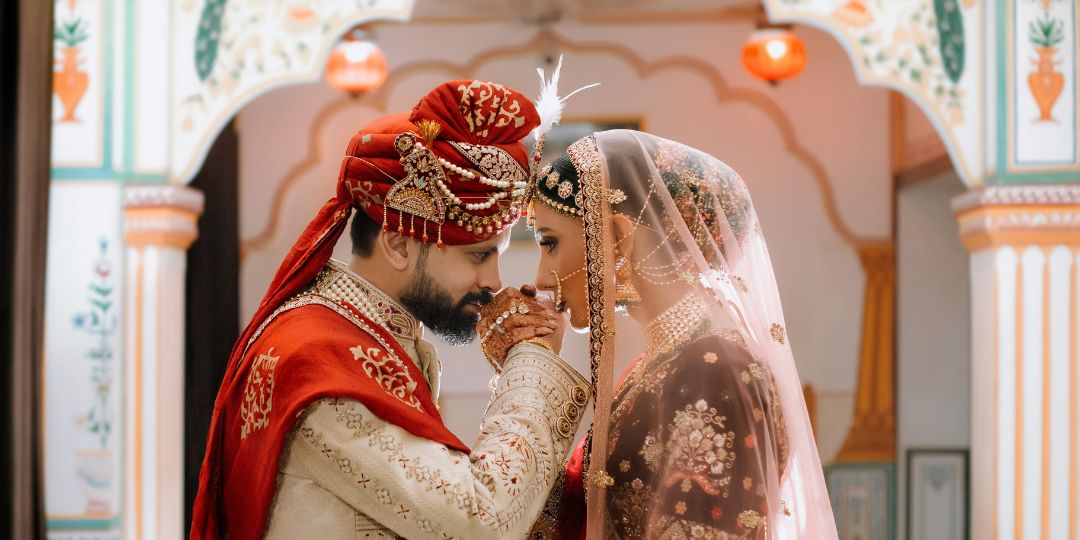
Perhaps you’re unsure what to expect from an Indian wedding if you’ve been invited for the first time. Among the many destination weddings, Indian weddings are undoubtedly among the most joyful and colorful, conveying the meaning of uniting not just two people but entire families and communities, symbolizing a bond that lasts seven reincarnations. Among the countless rituals that characterize the wedding ceremony, the Saptapadi (literally, the seven steps) is the most important moment of the Hindu ceremony, in which the couple takes seven steps around the fire, exchanging vows for each step. Interestingly, even today, many families consult astrologers to determine the couple’s compatibility and subsequently choose the wedding date, especially among the most high-ranking families or the most ancient lineages.
Hindu Wedding Rites and Ceremonies: From Mehndi to Traditional Wedding
Indian ceremonies are a riot of traditions and symbolism rooted in the mists of time. There are some ancient Indian wedding rituals, such as the Mehndi ceremony, which involves decorating the bride’s hands and feet with intricate henna designs. But let’s take it one step at a time.
A few days before the wedding, the future spouses exchange prayers, flower garlands, and gold rings in a celebration called Misri, where the groom’s parents give gifts to the bride as a symbol of good luck for a happy life together. Afterwards, the Mehendi ceremony takes place; it is believed that the dark color of the henna symbolizes the strength of the bond with her husband. This is followed by the Sangeet, a festive evening where families gather to sing and dance together. During Haldi, family and friends smear the newlyweds with a paste made of turmeric, milk, and sandalwood to purify and make their skin glow before the ceremony. A week before the ceremony, the bride is not allowed to see the groom.
The Hindu wedding ceremony often takes place under a richly decorated canopy called a mandap. At the beginning of the ceremony, the bride’s father entrusts his daughter to the groom through the Kanyadaan hand-holding ceremony. The bride’s father then takes his daughter’s right hand and joins it with the groom’s right hand. Meanwhile, the bride’s mother pours sacred water into the palm of the father’s hand, which flows onto her daughter’s hand and then onto the groom’s, symbolizing a blessing. During this ritual, Vedic hymns (sacred songs and prayers that constitute the Vedas, the most ancient sacred texts of Hinduism) are recited, while the groom promises the bride’s father to take care of her, repeating the vow three times. This is because, according to Hindu traditions, the number three symbolizes the cosmic cycle of creation, preservation, and destruction and is also connected to the union of body, mind, and spirit and to the balance between the three realms (heaven, atmosphere, earth).
Saptapadi is the central moment of the entire Indian wedding ceremony, in which the bride and groom circle seven times around a sacred square fire, reciting vows for their married life. If the bride is wearing a sari, it is customary to tie the end of it with the groom’s scarf and hold hands as they circle the fire seven times. Finally, the groom places a necklace of black and gold beads (mangalsutra) around the bride’s neck, symbolizing her status as a married woman.
At this point, the bride officially leaves her family home to join the groom’s family. It’s an emotionally charged moment, but how does it happen? Before leaving, the bride throws handfuls of rice and coins over her head, backward, toward her family, an ancient gesture representing a wish for wealth and prosperity for her birthplace. The bride’s father entrusts his daughter’s hand to his son-in-law, symbolically transferring the responsibility of caring for her.
Once the Vidaai ritual is complete, the ceremony is considered complete and the banquet begins. The reception, where authentic Indian food is naturally served, often includes hundreds of guests. It’s worth remembering that during the wedding, the bride is considered the representation of the goddess Lakshmi (goddess of prosperity and good fortune, protector of homes). In many traditions, she is asked to overturn a vase filled with rice with her right foot, symbolizing the arrival of wealth and prosperity in the family.
Differences between Hindi and Punjabi weddings
Punjabi weddings and Hindi (or Hindu) weddings are not the same, although they share some cultural similarities due to their shared geographic origins, namely northern India. Both weddings can last several days, include pre-wedding ceremonies such as Mehendi (henna) and Haldi (turmeric application), and include the groom’s procession (Baraat) with music and dancing. However, the Punjabi wedding (or Sikh wedding) takes place in a Sikh temple called a Gurdwara, and the main ceremony is called Anand Karaj, “ceremony of bliss.” The Hindi wedding, on the other hand, generally takes place under a canopy, the Mandap, often outdoors or in a temple, with the sacred fire, Agni, as the main witness to the celebration.
The main ritual for a Sikh wedding involves the newlyweds performing four rounds (called Lavan) around the sacred book, the Guru Granth Sahib. Conversely, in a Hindu wedding, the bride and groom perform seven rounds (Pheras) around the sacred fire. Punjabi weddings are known for being extremely joyful and energetic, with dances such as Bhangra and Giddha. Specific rituals such as the Jago (dancing vigil) and the Chooda (red bangles) are very common.
Colors, decorations, and music: the unique atmosphere of an Indian wedding
If you love minimalism, this style probably isn’t for you, but if you enjoy lavish, ornate weddings, Indian weddings are for you. Indian weddings are perhaps among the most colorful: vibrant colors like red, gold, orange, fuchsia, and bright green dominate the scene. If you’re looking for Indian wedding decor ideas for your wedding inspiration, you’ve come to the right place! Cushions, rugs, and drapes are essential, and even a canopy is essential, perhaps decorated with flowers and light drapes. Elephants with their trunks pointing upward are considered a good omen; you can use them to enhance your table setting as place cards. Plenty of lanterns and candles will create a more evocative atmosphere.
Naturally, music also plays its part, ranging from classical and solemn genres perfect for the ceremony to more lively ones perfect for the wedding dance party. Here are some Indian Wedding Dance Songs from famous Indian films: Gallan Goodiyaan; London Thumakda; Dil Chori; Ki Kariye Nachna a Aonda Nahin; Veerey Ki Wedding; Tenu Leke; Morni Banke; Dilon Ki Doriyan; Raat Ke Dhai Baje; Sadi Gali. In Italy, drums are often added to enhance the atmosphere. It’s customary for the bride and groom to also learn a Bollywood-style choreography to open the party.
Indian Wedding Dresses and Jewelry: Lehenga, Sari, and Bridal Looks
The Indian bride’s outfit is unique, and the dressing, performed by two close friends of the bride, is considered a sacred moment and can last up to half an hour. Traditionally, for the ceremony, the bride wears a bridal sari, a single piece of draped fabric up to nine meters long (usually six or seven meters), in red or orange, considered auspicious as they symbolize passion and love. The sari can weigh up to ten kilograms if made of raw silk, as is traditional, and is the last garment put on the bride. It must fall over the left shoulder in seven folds (seven is a sacred number that recurs frequently in Indian celebrations) and is customarily given as a gift from the groom’s family. The most common alternative to the sari is the lehenga, a three-piece outfit (long skirt, choli blouse, and dupatta shawl), ideal for brides and formal ceremonies.
Before dressing, the bride is bathed in milk and turmeric to make her skin radiant and smooth. She is then anointed with scented oils, and her hair is perfumed with incense and fresh jasmine. The Indian bride is adorned with numerous, clinking jewels, including bracelets, a maangtika on her forehead, earrings, a nose ring, a necklace, rings, and anklets. Bridal jewelry not only serves to adorn the bride but is also a symbol of inheritance, blessings, and new beginnings. Jewelry is often passed down from mother to daughter, generation to generation. The total amount of gold an Indian bride wears, including her dress and jewelry, must weigh seven kilograms. Gold occupies a central place in wedding jewelry, as it is considered a metal that brings prosperity and abundance for the future.
The Mangalsutra, with its black and gold beads, is believed to help regulate body temperature, absorb positive energy, and repel negative influences. Toe rings (Bichiya), worn on the second toe, are believed to be associated with improved reproductive health and hormonal balance. Bracelets, through their gentle, continuous contact with the wrist, are believed to promote blood circulation and the proper distribution of vital energy.
There are also beliefs linked to the wearing of certain jewelry. The Nath (nose ring), traditionally worn on the left nostril, is believed to stimulate a nerve connected to the female reproductive system, reducing menstrual discomfort and facilitating childbirth. The Maang Tikka and Borla, placed on the forehead, are associated with the Ajna Chakra and are believed to help strengthen intuition and mental clarity. The Kamarbandh (waist belt) is believed to help not only improve posture, but also aid digestion and strengthen the core. Finally, Payal (anklets), often made of silver, are believed to promote energy conduction and maintain the body’s electrical balance.
Superstitions or not, these customs are deeply rooted and part of Indian tradition, much like Anglo-Saxon brides, for good luck, wear something borrowed, old, new, and blue to their wedding. Of course, India is a vast continent, and each region has its own traditions and peculiarities.
Bridal makeup also follows the general trend and is characterized by a bold look that enhances the features with rich colors like gold, bronze, copper, purple, and red, often paired with a bold smokey eye. Essential features include the application of a bindi, a jewel or red mark on the forehead, voluminous lashes to add depth to the gaze, and precise contouring to sculpt the features.
Indian wedding planner Florence
If you’re wondering about the services and costs of an Indian wedding planner, let’s start with one thing: a good wedding planner must first understand the rules of Indian weddings and be familiar with their customs and traditions. Indian weddings often have between 100 and 300 guests, a considerable number that requires adequate facilities in terms of accommodations, wedding venue, and, last but not least, transportation, as well as adequate catering and decoration services.
When it comes to celebrations in cultures different from your own, a basic understanding of customs isn’t enough; you need a broad understanding, embracing the wide range of religious and regional differences that make every Indian wedding unique. Naturally, you also need the right knowledge for a highly specialized Indian food caterer like Haveli Indian Catering, traditional Indian musicians, henna artists, Indian celebrants for Sikhs, Hindus, or Muslims, and so on.
If you’re looking for guidance in organizing an authentic Indian wedding in Florence, Tuscany, as well as a close-knit team that meticulously takes care of every detail, I’m personally dedicated to ensuring my brides and grooms are impeccably prepared. My commitment is to make your dreams come true. This is the day you’ve always dreamed of. You only have one chance to make it perfect, and I’ll be by your side to ensure every moment is exactly as you imagined it… and even more beautiful.