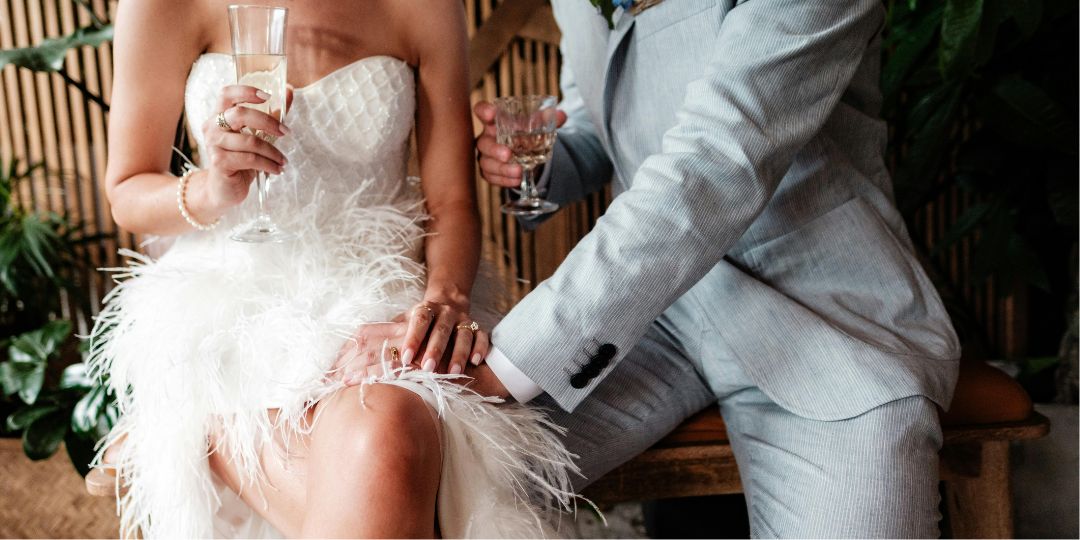
Different countries have different customs! Every culture has its own wedding traditions: in Italy, for example, it’s considered bad luck for the groom to see the bride before the ceremony; in England, a coin is placed in the groom’s shoe as a lucky charm; in America, it’s customary for the bride to wear something blue. Perhaps you’re not familiar with some of the more unique and unusual traditions; I’ve selected 10 just for you. Let’s discover them together!
1. Scotland: The “Blackening” of the Bride
“Blackening” is one of Scotland’s most bizarre and deeply rooted pre-wedding traditions, particularly prevalent in rural areas, the Highlands, and the Northern Islands. It is an evolution of an older “foot-washing” ritual, originally intended as a cleansing and purification ritual before the wedding. In the days leading up to the wedding, friends and family “kidnap” the bride (and sometimes the groom) with the aim of dousing them from head to toe with sticky substances such as molasses, rotten eggs, flour, feathers, mud, ash, and sometimes fish entrails. Yes, that last one is a bit naughty! After being “blackened,” the newlyweds are paraded through the city in public, often tied to the back of a van, amid the clatter of pots and pans banged by friends. This ritual is considered propitiatory and wards off future hardships. Despite being a chaotic tradition, it is celebrated with a jovial spirit, and in some cases, the ceremony concludes with the future spouses diving into the sea or a river to clean themselves. At times, excessive disorder has caused urban cleanliness problems, prompting local authorities to call for greater restraint.
2. Canada: The Stocking Dance (Quebec)
In French-speaking Canada, older brothers and sisters of the newlyweds who are not yet married wear colorful, silly stockings with bells, pom-poms, or ribbons and dance during the reception. The protagonist(s) must dance alone in the center of the dance floor, while guests surround them, cheering and jeering. During this performance, which is part of the veillées de danse and folk celebrations of Quebec, guests throw money at the dancers’ feet. The money thus collected (often several hundred dollars) is donated to the newlyweds as a gift for their new life. The ritual concludes with the siblings removing their silly stockings, often keeping them as a memento.
3. Denmark – Sock Cutting
Socks are always the protagonists, but this time we’re in Denmark, where there’s a fun post-wedding tradition called klipper sokker. After the newlyweds waltz (which must take place before midnight), the groom’s male friends pick him up, lift him into the air, remove his shoes, and proceed to cut off the toes of his socks with scissors. This is supposed to symbolize that he is now a married man and no longer needs whole socks. The custom originates from the era when men only had one pair of good socks. Removing the toes rendered the sock useless for approaching other women, ironically representing the end of single life. According to tradition, the bride must then mend her husband’s socks, symbolizing her first “duty” in marriage.
4. South Korea: Beating the groom’s feet
Shortly after the wedding ceremony, the groom’s friends remove his shoes and socks, pin him down by the ankles, and begin hitting the soles of his feet with a stick or dried fish. The ritual is known as Falaka or Bastinado, and sometimes called Dongsangnye. This is a playful way to test his endurance and temperament before the wedding night. During the “test,” the groom is typically asked questions or riddles about married life to assess his mental alertness and memory. Another unusual custom in South Korea is that of giving wooden ducks as a sign of blessing. In Korean culture, the bird is considered a symbol of fidelity and harmony, essential qualities for a lasting relationship.
5. China (Tujia Region): A month of weeping
In the Tujia region, located primarily in the mountainous regions of central China (Hunan, Hubei, Guizhou, and Chongqing), the bride must weep and sing mourning songs for an hour every day for 30 days before the wedding. After ten days, her mother joins in, followed by her grandmother and other female relatives, such as sisters and friends, creating a sort of “crying song” with nostalgic and poetic tones that evoke the regret of leaving her family and gratitude for the upbringing she received.
It is said that the tradition began during the Warring States Period (475-221 BC), when the mother of a Zhao princess cried at her daughter’s feet before leaving to marry the King of Yan, begging her to return soon. In the past, the ability to weep in an “artistic” and moving manner was seen as a measure of the virtue and intelligence of Tujia women. A bride who didn’t shed tears risked being mocked by the neighbors, while one who cried well was highly respected. Even though one weeps, this tradition doesn’t express unhappiness or sadness. Rather, it’s an emotional celebration, an act of love, gratitude toward one’s parents, and a rite of passage.
6. Greece: Money Dance and Plate Breaking
In addition to breaking plates to ward off bad luck, in many parts of Greece, the “money dance” is practiced, where guests pin banknotes to the newlyweds’ clothes while dancing to help them financially in their new beginnings. The newlyweds perform the central dance (usually a traditional dance such as Sirtaki or Ballos) while friends and family approach to throw banknotes or pin them to the newlyweds’ clothes, expressing their heartfelt wishes. The money thrown or pinned to the clothes is not only a monetary gift, but also symbolizes good luck, abundance, and support for their life together. As for the custom of breaking plates, in the past, the loud noise and commotion of the breaking were thought to ward off evil spirits, thus offering protection to the couple or spouses from negative energies. Although in the past, real ceramic plates were broken, today, for safety reasons and to prevent possible injuries, plates made of special plaster or thin ceramics designed to break easily and more safely are often used.
7. India: Wedding with trees
If an Indian woman is born under a particular astrological influence of Mars (Manglik dosha), it is believed to bring bad luck to her spouse. To ward off bad luck, the bride marries a tree, which is then cut down or removed, freeing her from any enchantment before uniting with her human companion. Plants such as the banyan or peepal are considered sacred. Marriages between humans and trees evoke well-being, fertility, and protection from negative forces, symbolizing the profound connection between Indian culture, nature, and astrology.
8. Germany: Polterabend (Breaking Plates)
The evening before the wedding, guests gather at the newlyweds’ home to smash plates, cups, and ceramics. According to the proverb “Scherben bringen Glück” (shards bring good luck), the noise serves to ward off evil spirits. The newlyweds must then clean all the shards together: this symbolizes the teamwork needed to overcome obstacles. But be careful! Breaking glass or mirrors is absolutely forbidden, as this is considered a bad omen for future happiness.
9. Pinched bride, lucky bride
For Egyptian brides, it’s a good luck sign to be pinched by all the guests in turn. During the event or celebration, friends and unmarried guests give the bride small pinches, usually on the arm or knee. This act is believed to bring good luck to the bride, but not only that. For the women who perform the pinch, the meaning is even more special: it’s believed that this behavior will ensure they are the next to receive a marriage proposal. This custom is linked to a popular Egyptian saying that “a pinch can guarantee a marriage within a week.”
10. Swapping clothes in Denmark
According to Danish tradition, to protect newlyweds from evil spirits, the groom and bride may meet in each other’s clothes. This superstitious tradition, part of Danish wedding folklore, serves to protect the couple from unfavorable energies on their special day.
Which of these traditions struck you the most? Did you know them all? Are there any other unique customs you know of? I’d love to hear more! If you’re looking for help planning your wedding, contact me and tell me about your vision. I’ll help you develop it!