
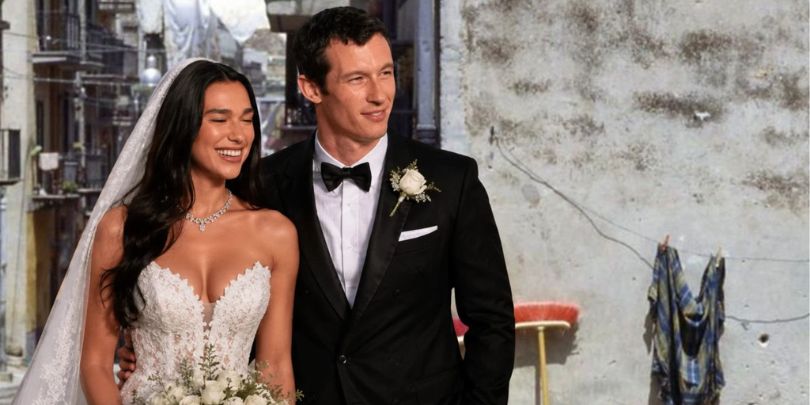
There comes a moment when entertainment news stops being mere news and becomes food for thought. The wedding of Dua Lipa, one of the most influential artists on the international music scene, celebrated in Southern Italy, inevitably turned the spotlight on our region. Even more interesting was the fact that, after the celebrations, the couple chose to spend some time relaxing in Tropea, Calabria, strolling through the alleys of the historic center and savoring the local cuisine. For many, it was merely a curiosity for gossip. For those who work in tourism and destination weddings, however, it is a much more important signal.
When a wedding becomes a message for a territory
Every summer, millions of people choose Italy as their holiday destination. Some come for the sea, others for the food, still others for the history and art. Then there are those who choose our country to celebrate one of the most important days of their lives: their wedding. In recent years, the destination wedding phenomenon has grown exponentially, transforming from a niche market to a truly strategic tourism segment. Couples from the United States, Canada, Australia, the United Kingdom, and Northern Europe decide to get married in Italy because they’re looking for something that doesn’t exist in their own country: an authentic experience, combining landscapes, culture, gastronomy, history, and beauty.
For this reason, when an international personality like Dua Lipa chooses Southern Italy to celebrate her wedding and then spend a few days exploring the beauty of Calabria, the news shouldn’t just be of interest to entertainment magazines, but also to those involved in tourism, entrepreneurs, and institutions. In short, it should be of interest to everyone who believes Calabria still has enormous room for growth on the international stage.
It’s clear that a wedding like this is much more than a private event: it’s a powerful communication tool! Every photograph posted on social media, every article, every video shared by newspapers and television contributes to building a collective imagination. Millions of people see views, landscapes, architecture, sunsets, flavors, and atmospheres they perhaps never knew existed. It’s local marketing in its most spontaneous form.
And this is precisely why destination weddings today represent an extraordinary opportunity for Southern Italy. Over the past twenty years, Tuscany, the Amalfi Coast, Lake Como, and Puglia have transformed weddings into high-value tourism products, attracting couples from all over the world and generating a livelihood that involves hotels, restaurants, transportation, artisans, photographers, musicians, tour guides, and farms. Every international wedding is a small economic ecosystem that involves more than just the bride and groom, but also involves dozens of professionals and hundreds of people, leaving a lasting impact on the region even after the guests have departed. Many guests return in subsequent years as tourists. Others recommend those locations to friends and family. Still others purchase local products upon returning home. It’s a type of tourism that generates relationships even before generating revenue.
5 wedding trends Dua Lipa’s wedding could set in motion in 2026
Every major international wedding leaves a legacy. Not just photographs destined to travel the world, but also details that, in the months that follow, end up inspiring thousands of couples. Dua Lipa and Callum Turner’s wedding is no exception. Beyond the media hype, some of the choices clearly illustrate the direction luxury weddings are taking: less ostentation and more experience.
1. The wedding as a weekend, not as a day
The celebration unfolded over three days, with different moments dedicated to guests: a welcome party, the ceremony, a final brunch, and free time. This is an increasingly popular format among international couples who want to transform their wedding into a shared journey with friends and family.
2. Southern Italy as a new icon of luxury
For years, Tuscany and Lake Como dominated the destination wedding market. Today, Sicily and Calabria are gaining attention thanks to a more discreet luxury, combining authenticity, natural landscapes, and local culture. The choice of Palermo for the wedding and the subsequent stop in Tropea perfectly illustrate this evolution.
3. Extreme customization
From the fans embroidered with the couple’s initials to the coordinated table settings, each element was designed to tell a personal story. Contemporary wedding design moves away from standardized arrangements and focuses on unique and unrepeatable details.
4. Less formality, more emotion
After the elegant ceremony, there’s time for relaxed moments, an outdoor brunch, and socializing. It’s an increasingly popular trend: guests aren’t just looking for a flawless reception, but an authentic experience to remember.
5. The territory becomes the protagonist
Perhaps the most compelling message is precisely this. The wedding wasn’t built around a reception hall, but around a destination. The images of Sicily, the allure of the Mediterranean, and the atmosphere of Southern Italy became an integral part of the event’s narrative. This is precisely the power of a destination wedding: transforming a territory into the protagonist of a love story.
Tropea as an international case study: when a territory becomes a destination
In recent years, Tropea has gone from being one of Southern Italy’s most beloved seaside resorts to a true symbol of experiential tourism in the Mediterranean. International rankings, articles in major travel publications, and the growing number of foreign visitors demonstrate that its appeal extends far beyond its crystal-clear waters or its historic center overlooking the sea. Tropea is indeed an interesting case because, within just a few kilometers, it encompasses everything an international couple seeks when imagining a wedding in Italy: authenticity, gastronomy, history, breathtaking views, and a pace of life that’s far removed from the mainstream destinations. It’s therefore not surprising that, after their wedding in Sicily, Dua Lipa and Callum Turner also chose Tropea for a break from the media hype. A spontaneous gesture, likely driven by a desire to experience an authentic place, but one that also offers food for thought about Calabria’s tourism potential.
As a wedding planner, I’ve had the opportunity to observe this phenomenon up close. A few years ago, I organized a Canadian couple’s wedding in Tropea at the same venue, and I vividly remember the guests’ amazement. Many of them had arrived knowing next to nothing about Calabria and left with a completely different perception of the region. More than the wedding, what they talked about once they returned home were the sunsets over the Tyrrhenian Sea, the scent of bergamot, the local cuisine, the hospitality they experienced, and the relaxed atmosphere of the historic center’s alleyways. This is the true value of a destination wedding: transforming a private event into a tool for promoting the region.
An international wedding generates wealth not only because of the location chosen by the couple. It involves hotels, restaurants, transportation companies, artisans, local producers, tour guides, businesses, and local professionals. Guests arrive several days before the ceremony, explore the surrounding area, purchase local products, and often return as tourists in subsequent years. According to industry estimates, an international wedding can generate an average stay of three or four nights for dozens of guests and a total expenditure that easily exceeds hundreds of thousands of euros, including hospitality, catering, services, excursions, and local shopping. This economic impact extends across an entire supply chain and can generate benefits that extend well beyond the wedding day.
For this reason, destination weddings should not be considered merely a segment of the events industry, but a true tourism development strategy. Every foreign couple who chooses Calabria becomes an ambassador for the region in their own country, sharing its story through photographs, videos, and memories shared with thousands of people. The question, therefore, is not whether Calabria has what it takes to compete with major Italian destinations. The real question is whether it is ready to collaborate and coordinate the valorization of a heritage that already exists and that the world is only just beginning to discover.
Why we need territorial management: the role of Heritage Calabria
When it comes to destination weddings, we tend to think that simply having a spectacular location or breathtaking views is enough to attract international couples. The reality is much more complex. A region becomes an international destination when all stakeholders in the supply chain work together, sharing a common vision. This is what happened in Tuscany, Lake Como, the Amalfi Coast, and, more recently, Puglia. Success wasn’t the result of the work of a single accommodation provider or wedding planner, but of the ability to build a recognizable and coherent ecosystem.
Calabria today boasts an extraordinary natural and cultural heritage, yet continues to present itself to the market in a fragmented manner. Each professional advertises their own service, each venue presents itself, each operator promotes its own region, often without a shared language or a common strategy. The result is that there are excellences, but no destination. Yet destination weddings are probably one of the few sectors in which collaboration generates more value than competition. A photographer needs quality venues, a venue needs skilled wedding planners, a wedding planner needs reliable suppliers, hotels need restaurants, restaurants need local producers, and everyone needs infrastructure, transportation, and tourism promotion. You can easily understand how this is an integrated and potentially perfect ecosystem. It’s a chain in which each link strengthens the next.
For this reason, it’s crucial to envision a regional management team capable of coordinating diverse skills without replacing individual operators. A place to discuss, share best practices, identify critical issues, and build a shared identity for Calabria as an international wedding destination. It’s precisely from this reflection that Heritage Calabria was born. Not as a commercial brand or even a trade association, but as a cultural project that puts the region at its heart. The idea is simple: to promote Calabria through emotional tourism, portraying it as a land of authentic experiences, hospitality, history, and beauty. Foreign couples don’t just choose a villa or resort; they choose the scent of citrus groves, the sunset over the sea, the village to stroll through the evening before the wedding, the wine tasted during a visit to the cellar, the artisan workshop discovered almost by chance, the traditional cuisine shared with friends from all over the world. They choose a story to live.
Heritage Calabria aims to contribute to building this narrative through editorial content, industry meetings, opportunities for discussion, networking activities, and initiatives that connect the world of weddings with that of tourism, hospitality, and regional promotion. The goal is not to create yet another wedding portal, but to foster a culture of collaboration. We firmly believe that a destination’s success never belongs to a single company; it belongs to a region that has learned to present itself to the world with one voice.
Beyond the Gossip: Building a Destination
Calabria has all the characteristics to enter this market. It boasts an extraordinary landscape. Its villages are still authentic. It has a unique gastronomic tradition. It has a welcoming culture that surprises those who discover it for the first time. Yet it continues to remain on the fringes of the great Italian destination wedding narrative. Why? The answer probably isn’t the beauty of the region, but rather the ability to convey it. Over the years, I’ve been fortunate enough to work with couples from various countries, and there’s a phrase I’ve heard over and over again: “We never imagined Calabria would be like this.” It’s a pleasing phrase, but at the same time it should make us reflect. Because it means that the problem isn’t what Calabria is; the problem is what the world thinks Calabria is, and that’s a huge difference.
An extraordinary territory that no one properly presents will continue to remain a hidden gem. Conversely, there are destinations that have built their international reputation thanks to a coherent, shared, and consistent narrative over time. Sicily is an example, as is Puglia, and Tuscany, needless to say, has been doing so for decades. Calabria, on the other hand, still seems to tell its story through isolated incidents, without a shared strategy. For this reason, the visit of an international celebrity should be seen as an opportunity to question the region’s future, not so much because a famous singer dined in Tropea, but because that gesture demonstrates something very simple: Calabria is already desirable! Perhaps more so than the Calabrians themselves imagine. The key, then, is not how to attract international tourism, but how to transform this spontaneous interest into a long-term strategy. And it is precisely here that destination weddings can become an extraordinary driver of development. Perhaps the time has come for Calabria to start telling its own story.

